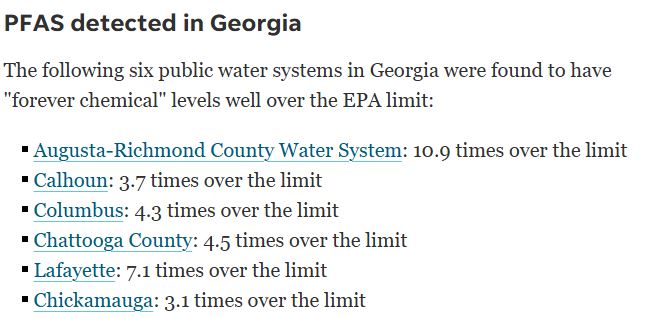

Testing data submitted to federal regulators shows the City of Calhoun’s public drinking water system recorded PFAS levels 3.7 times higher than the Environmental Protection Agency’s established limit, placing it among several Georgia communities reporting elevated concentrations of the so-called “forever chemicals.”
The results were highlighted in a national map compiled by USA Today using test data submitted by water systems to the EPA as part of ongoing monitoring efforts for PFAS contamination in public drinking water.
PFAS, or per- and polyfluoroalkyl substances, are long-lasting man-made chemicals that break down very slowly over time. Because they have been widely used in products designed to resist heat, water and oil, the chemicals have become common in the environment.
According to the EPA, PFAS can now be found in water, air, soil, fish and even human blood in varying levels. Scientific studies have shown exposure to some of these chemicals may be linked to harmful health effects in both humans and animals.
In 2024, the EPA established legally enforceable limits for six PFAS chemicals in public drinking water systems. Under those rules, public water systems must monitor for the chemicals and take steps to reduce levels if they exceed federal standards. Utilities are also required to notify the public when violations occur.
Calhoun was one of six Georgia public water systems identified as exceeding the EPA’s limits. The other systems listed in the report include:
-
Augusta–Richmond County Water System, at 10.9 times the EPA limit
-
LaFayette, at 7.1 times the limit
-
Chattooga County, at 4.5 times the limit
-
Columbus, at 4.3 times the limit
-
Chickamauga, at 3.1 times the limit
The data is part of a nationwide effort to monitor PFAS contamination and provide greater transparency to residents about potential exposure levels in their drinking water.
For residents concerned about PFAS, the EPA notes that not all household water filters remove the chemicals. The agency recommends looking for filters specifically certified to reduce PFAS contamination. Options that may help reduce the chemicals include granular activated carbon (charcoal) filters, reverse osmosis systems, and ion exchange resin filters, which work by trapping or separating contaminants as water passes through the system.